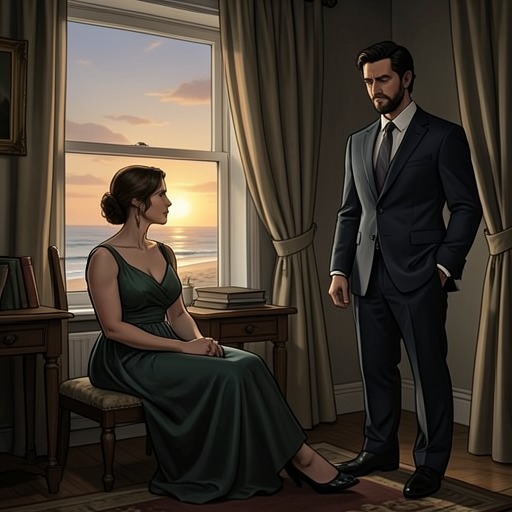
Victoria
Match PointVictoria is Victor Bello’s seven-year-old daughter, raised in the orbit of beach volleyball and surrounded by adults whose work and loyalties are shaped by the sport. Her importance lies not in a separate competitive career, but in the intimate life she shares with her father and Willa Ashford: she makes their family bond visible, while her youth gives the adults’ choices about travel, danger, and protection immediate personal stakes.
Family and Early Upbringing
Victoria’s mother, Sara, was an Australian beach volleyball star who died of breast cancer when Victoria was less than a year old. After Sara’s death, Victor devoted himself to parenting his daughter. In the early years, he kept Victoria’s crib close to the court while he coached Willa Ashford and Colleen Sherman. The court was therefore not merely her father’s workplace: it was part of the setting in which Victoria grew up and the place where the adults closest to her spent their lives.
One of Willa’s remembered scenes from that period gives Victoria’s childhood a distinct, physical shape. Victoria took her first unsteady steps on the sand, and the adults cheered as if she had won a gold medal. She laughed and clapped at their attention, then dropped onto her bottom; after a brief look of confusion, the sand caught her interest. She filled her palms and tossed it into the air. The memory survives for Willa as a tender picture of shared family life, and of Victoria discovering the court on her own terms rather than simply watching from the edge.
At seven, Victoria is described as likely to grow tall and lanky like her father and her mother. She is already showing an interest in playing, telling Willa that she is getting good. Her mother’s athletic background and the court’s place in her upbringing make that interest resonant, but the story presents possibility rather than a settled athletic future: Victoria is still a child, and no competitive career is established.
Willa Ashford’s Place in Her Life
Willa’s connection with Victoria is part of a wider bond with Victor Bello. Willa regards Victor and his daughter as her only family after Colleen’s disappearance and presumed death, and she says she does not want to jeopardize her relationship with Victor. Although outsiders have questioned the closeness between Willa and her longtime coach, Willa understands their bond as friendship and mutual respect, not romance. Her affection for Victoria belongs within that family-like relationship.
Their familiarity appears in small, repeated gestures. When Willa arrives at Victor’s home, Victoria greets her eagerly and asks whether she has come to play. Willa bends to hug her, ruffles her curly brown hair, and promises that they might play later, after she has spoken with Victor. She also gives attention to Max, the family dog, before going inside. These ordinary exchanges establish a relaxed intimacy: Victoria expects Willa to be glad to see her, and Willa responds with the warmth of someone who is already part of the child’s life.
Victoria also welcomes Colt Fontaine in her own fashion. When she opens the door to him, she introduces herself and asks if he is there to see her father. Later, she calls him “Mr. Horsey,” a teasing nickname that he accepts with amusement. The encounter briefly sets the child’s easy sociability against Colt’s professional role as a security operative. To Victoria, he is not introduced first as part of a protection detail; he is a new adult at her father’s house whom she can greet and joke with.
Volleyball, Travel, and Protection
The sport is a source of pleasure for Victoria as well as the adults’ profession. She is excited about the coming games and expects to watch them; she has also imagined being the ball girl. When Victor tells her there has been a change of plans, she is disappointed to learn that her grandparents are coming to take her back to Santa Barbara. Her reaction makes clear that leaving means missing something she had anticipated, not simply changing where she will stay.
Victor had already expected her grandparents to look after her while he went to Serenidad, where Willa Ashford and Tabby would compete. He explains that being away from Victoria is difficult and that she loves the sport. Once the plans change, he promises a substitute attraction: a visit to see Mickey and Minnie. It is a practical attempt to soften the disappointment, and it underlines the tension between Victoria’s wish to be included in the games and the adults’ decision to have her stay with family instead.
The adults’ protective decisions extend beyond the trip. After an incident leaves Victor with a mild concussion, he says he does not want Victoria to know what happened and plans to tell her that he tripped and hit his head on a door. The account does not make Victoria a participant in the incident; instead, it shows Victor trying to keep its circumstances from reaching her. In a story where security concerns shape the adults’ movements and arrangements, her removal from the immediate situation is one way they attempt to preserve a child’s ordinary world.
Narrative Role
Victoria’s scenes give emotional substance to the relationships surrounding Willa’s return to competition. Willa’s decision to play again follows Colleen’s loss and is tied to preserving the legacy they built together. Yet Willa’s life is not defined only by volleyball or grief: her affection for Victoria, and her place in the Bello household, show another source of belonging. The child is among the family Willa fears losing, and their easy embraces make that attachment concrete without requiring a formal declaration.
Victoria also embodies the personal cost of a schedule organized around professional sport and security. She wants to watch the games and hopes to take part as a ball girl, but her father’s travel plans and the adults’ protective arrangements take precedence. The narrative does not frame her disappointment as a rejection of the sport or of her father; it places a child’s anticipation beside responsible adult decisions. Her role is small in plot terms but revealing in human ones: the court is where she first learned to walk, where she expects to play, and where the adult relationships that shelter her have taken shape.